Click to hear God's Name!

יהוה referring to his nation as Ephraim
is a Tender Expression of His Great Love

Helping us really "KNOW" God!
(Pro 30:4; John 15:11-16)

Referring to his Nation of Israel, God tenderly expressed that He taught Ephraim to walk and carried them in his arms. He lovingly cared for and protected them. (Hosea 11:3-4) His referring to his nation of people as Ephraim, rather than Israel, carried special tenderness and meaning. The tribe of Ephraim [Jacob's grandson, who received inheritance as a son, so as to become a tribe of the nation] was special in many ways, including their grave sins and their heartfelt repentance. This expression has special meaning for others of us who have been less than exemplary in our lives. יהוה is showing, if we love Christ, He still loves and cares for us no matter our past. We who love Christ are adopted as sons and daughters of Abraham, and share in the love God has for Ephraim. (Gal 3:19-29)

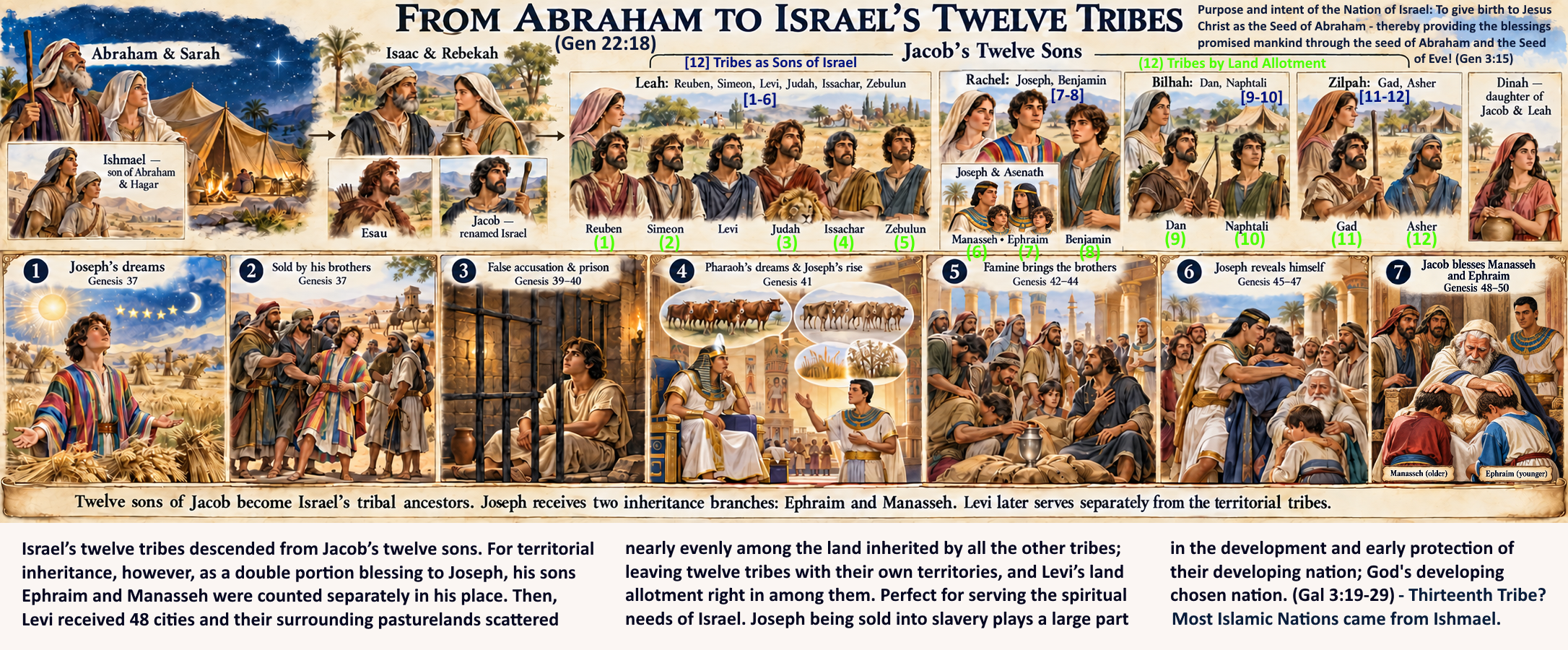
The scriptural explanation for that is below. The relationship between Abraham, Isaac, Jacob, Joseph, Manasseh, and Ephraim unfolds as a family line that became a covenant nation. Ephraim’s later role comes from prophecy, blessing, political dominance, and rebellion.

1. Abraham — The Covenant Beginning

God first established the covenant with Abraham. Abraham was promised that his offspring would become a great nation and that all families of the earth would be blessed through him.

God promised to make Abraham into a great nation, bless him, make his name great, and bring blessing to all families of the earth through him.

Abraham had Isaac as the promised son.

2. Isaac — The Covenant Continues

The covenant passed specifically through Isaac. God confirmed to Isaac the oath He had sworn to Abraham.

God told Isaac that He would be with him, bless him, give the land to his offspring, and multiply his descendants as the stars of heaven.

Isaac then had Jacob and Esau. The covenant line passed through Jacob.

3. Jacob — Israel and the Twelve Tribes

God renamed Jacob “Israel.” From Jacob came the twelve sons whose descendants became the twelve tribes of Israel.

Jacob was given the name Israel after wrestling and prevailing.

One of Jacob’s sons was Joseph.

4. Joseph — Preservation and the Double Portion

Joseph was sold into Egypt but later became ruler under Pharaoh. Through Joseph, God preserved Jacob’s family during the famine.

Joseph had two sons in Egypt:

These two sons became extremely important because Jacob adopted them as his own tribal sons.

Jacob declared that Ephraim and Manasseh would be counted as his own sons, like Reuben and Simeon.

This effectively gave Joseph a double inheritance in Israel:

Joseph himself does not usually appear later as one single tribe because his inheritance was divided into these two tribes.

5. Why Ephraim Was Elevated Above Manasseh

Although Manasseh was the firstborn, Jacob intentionally gave the greater blessing to Ephraim.

Jacob said Manasseh would also become a people, but Ephraim would be greater, and his descendants would become a multitude of nations.

This was prophetic. Ephraim later became one of the strongest and most influential tribes of the northern kingdom.

6. The Kingdom Divides

After Solomon, the nation divided into two kingdoms.

The southern kingdom was centered in Judah and was often called “Judah.”

The northern kingdom included the other tribes and was often called “Israel,” “Samaria,” or “Ephraim.”

Ephraim could stand for the whole northern kingdom because Ephraim became the leading tribe of the north.

7. Examples of Ephraim Representing the Northern Kingdom

Hosea 4:17
Ephraim is described as joined to idols. In context, Ephraim represents more than one man or one small family group; it speaks of the northern kingdom’s spiritual condition.
Isaiah 7:17
Isaiah refers to the time when Ephraim departed from Judah, meaning the division between the northern kingdom and the southern kingdom.

8. Ephraim Became Symbolic

Ephraim came to symbolize northern Israel: politically powerful, spiritually wayward, and yet still remembered by God.

Jeremiah 31:20
God speaks of Ephraim as a dear son and a beloved child, showing that even in correction, God still remembered Ephraim with compassion.

So Ephraim became both a representative name for the northern tribes and a picture of wayward covenant people whom God still intended to restore.

9. The Family Line

The relationship can be summarized like this:

  1. Abraham
    1. Isaac
      1. Jacob, also called Israel
        1. Twelve sons, becoming the twelve tribes
          1. Joseph
            • Manasseh
            • Ephraim

Ephraim was the younger son of Joseph, but Jacob gave him the greater blessing. Ephraim later became dominant in the northern kingdom. Therefore, “Ephraim” became a biblical shorthand for the northern nation of Israel.

10. A Larger Biblical Pattern

This also fits a repeating biblical pattern:

God’s mercy, not human will or human running, determines the outcome.

The elevation of Ephraim fits that larger pattern throughout Scripture. God repeatedly overturns normal human inheritance expectations to accomplish His purpose.

11. Ephraim as the Erring Nation Still Loved

“Ephraim” became more than merely a tribal name. It became:

That tension is seen especially in Hosea and Jeremiah.

Ephraim as the Erring Nation

God repeatedly condemns Ephraim for:

Hosea 4:17 (WEB)
“Ephraim is joined to idols. Leave him alone!”
Ephraim represents the spiritually corrupted northern kingdom devoted to idolatry.

And yet immediately surrounding such judgments are statements of grief, compassion, and longing.

Tender Compassion Despite Rebellion

One of the clearest passages is:

Jeremiah 31:20 (WEB)
“Is Ephraim my dear son? Is he a darling child? For as often as I speak against him, I still remember him dearly. Therefore my heart yearns for him. I will surely have mercy on him,” says ????.
Though Ephraim is repeatedly rebuked, God still speaks of him with tenderness and compassion.

That is remarkable because:

So Ephraim becomes almost a symbol of:

Hosea Expands This Theme

Hosea especially presents Ephraim almost like:

Yet God says:

Hosea 11:8 (WEB)
“How can I give you up, Ephraim? How can I hand you over, Israel?”
“Ephraim” and “Israel” are used almost interchangeably, showing Ephraim had become shorthand for the northern kingdom.

Notice the parallel:

They are nearly interchangeable there.

That is one of the strongest proofs that “Ephraim” had become shorthand for the northern nation itself.

A Deeper Pattern

Ephraim’s story mirrors a larger biblical pattern:

In that sense Ephraim becomes a picture not only of ancient northern Israel, but of the tragedy of covenant people drifting from God while still being called back by Him.

Link note: Scripture references were matched against the uploaded BibVersesFileList.txt list. Matched references were linked to actual filenames in ../BibleVerses/. References with no matching file in the list were left as plain text: Hosea 4:17, Isaiah 7:17, and Jeremiah 31:20.